Long-form histories of Linux distributions — how they started, how they ended, and what still runs. Written from release notes, mailing lists and archives, not from memory.
Piece
History, from archived captures
Covers
2005-10 → 2006-08, and the archives as they stand in 2026
Published
Verified
Sources
14, listed with access dates
This domain was lxnay dEsigN, the home of RR4/RR64 Linux — later Sabayon — from 2005 to 2006. It changed hands several times afterwards and was re-registered in 2026 by the publisher of Still Seeding. I am not Fabio Erculiani and am not affiliated with the Sabayon project, MocaccinoOS, matrixOS or the Gentoo Foundation.
The board: what a one-man distro’s forum was actually reporting
If you followed a link to /forum/viewtopic.php on this domain, you were sent to a post made at 20:20 on Sunday 18 June 2006: the release report for RR4 Linux 3.0 RC1. The board it lived on reported 4,117 posts and 820 registered users seventeen days later. That board was the distribution’s entire support organisation, and it is gone. This is what was on it.
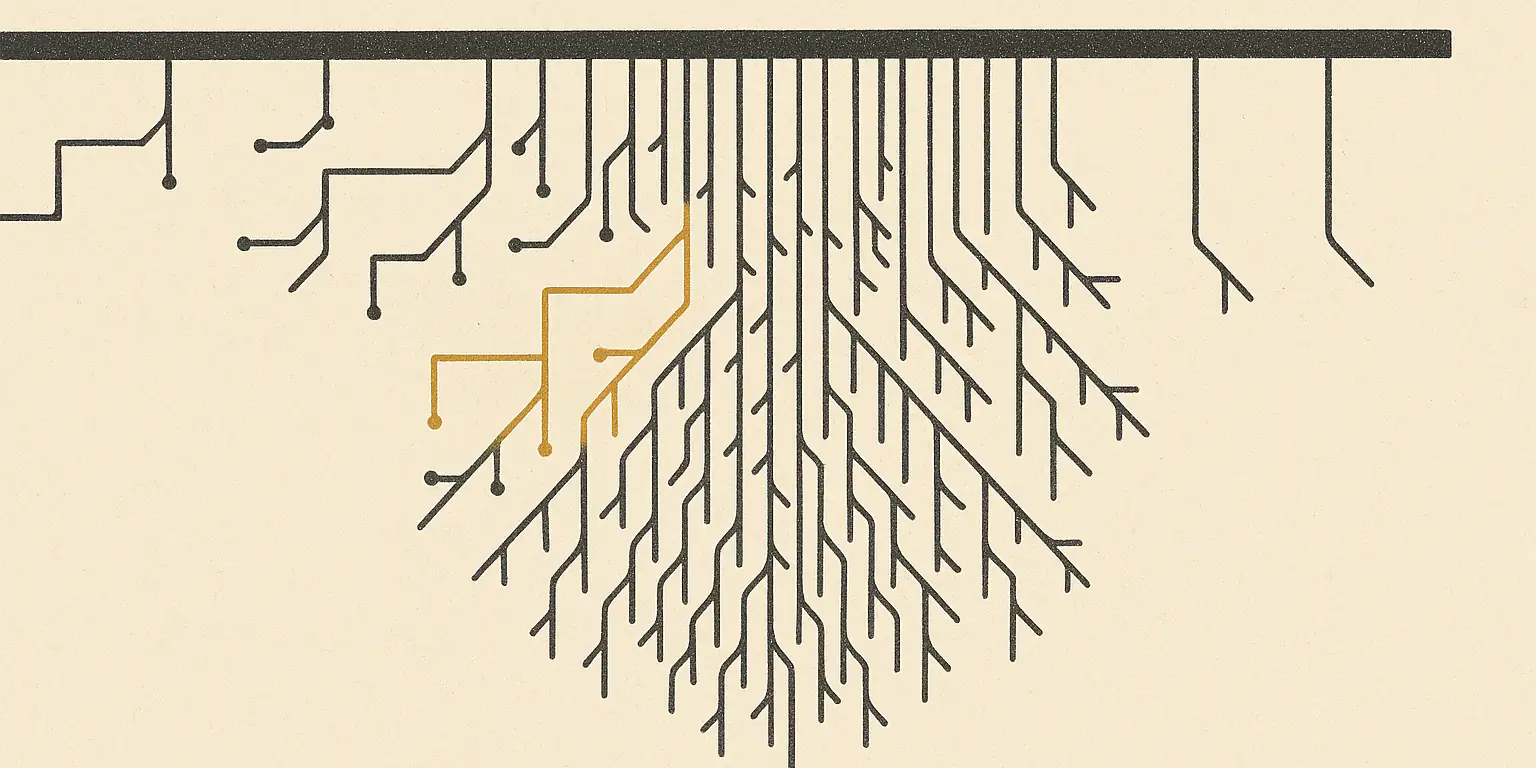
The board drawn as what it was: one horizontal rule with everything hanging off it. The bar is the board itself; each descending line is a topic, each fork a reply. The sparse left is late 2005 — four forums, 127 topics, 709 posts. The thicket is the eight months to July 2006, when the same board carried 737 topics and a counter reading 4,117. The gold cluster is the release report of 18 June 2006 — the one thread here that anything outside the board is known to have linked to. The two lines still descending at the far right are not the board thinning out; they are what is reachable in 2026, the Internet Archive’s two collections for the forum host and the wiki host. Neither the count of lines nor their spacing is a measurement — the table below is the record, and this plate is only its shape.
The distribution was an installable Gentoo-based live DVD, released as RR4 for 32-bit machines and RR64 for x86-64, renamed Sabayon Linux in the summer of 2006 RR4 / RR64 · Renamed · Verified 2026-08-04. The release engineering has its own piece. This one is about the room the users stood in — the part that did not survive, and a better record of what a distribution was actually like than any announcement written by the person shipping it.
Two captures eight months apart are the entire growth curve
The Internet Archive holds a capture of the board index from 24 November 2005. Four forums existed: General Discussions, Italian Discussions, and one each for the RR4 and RR64 live DVDs. Between them, 127 topics and 709 posts. There were 149 registered accounts, the most people ever online at once was 15, and that record had been set twelve days earlier.
The next useful capture is 5 July 2006, archived at 22:35:59 UTC, with the page’s own clock reading 23:23 board time. Ten forums, 737 topics, 820 registered users, and a total-post counter reading 4,117. The concurrency record had moved to 30 people, set on 19 June — the day after the RC1 release report went up.
lxnaydesign.net /forum/ — Internet Archive capture 2006-07-05 22:35:59 UTC
total posts 4117 · registered users 820 · newest user Les_Sr · most ever online 30 (2006-06-19) · phpBB 2.x
Thirty people at once was the peak load on a project that was, in the same period, shipping releases every few weeks on two architectures, running its own mirrors and torrents, publishing kernel configs and package manifests, and answering install questions in two languages. Here is the whole board, both captures side by side.
The board, as its own index reported it — two captures
Forum (name at each capture)
2005-11-24 topics / posts
2006-07-05 topics / posts
General Discussions
24 / 93
93 / 469
Italian Discussions
24 / 170
137 / 823
Off Topic
—
27 / 133
RR4 LiveDVD → Sabayon x86
69 / 374
280 / 1482
RR64 LiveDVD → Sabayon x86-64
10 / 72
173 / 1060
Sabayon bioEDITION
—
2 / 3
Distro Development (invite only)
—
17 / 87
OFFICIAL: Howto and Tutorials
—
6 / 7
Version Release Notes
—
2 / 2
bioEDITION Documentation
—
0 / 0
Visible total
127 / 709
737 / 4066
Board counter
709
4117
In November the two columns agree exactly. In July they are 51 posts apart, and the software tells you where those 51 went. phpBB 2 does not keep a hand-maintained board total: it adds up the post column of every forum row in the database, with no permission check at all, and then prints an index listing only the forums the visitor is allowed to see. A guest on 5 July 2006 was therefore reading a 4,117-post board through a 4,066-post window.
Which is a small finding in itself. The invite-only Distro Development section was listed, all 87 posts of it, so whatever held the missing 51 was hidden more completely than the section the project itself called closed — a moderators’ or administrators’ forum, most likely, of the kind every board of that size grows. The number is not a mystery; it is the shadow of a room we cannot see into.
The board’s shape says the project had already learned to delegate
Three things in that table are worth more than the totals.
Italian Discussions is the second-biggest forum on the board. In November 2005 it held 24% of all posts; in July 2006, 823 posts across 137 topics — more topics than the English general forum. The author was in Arco, in Trentino, and a fifth of everything said about this distribution was said in a language most of its downloaders could not read. That is not a curiosity. Early free-software documentation is stranded in national-language forums at a scale nobody has ever measured, and search engines have spent twenty years quietly ranking it below English rewrites of the same fix.
Distro Development was invite-only and had seven moderators. The July capture names them: cvill64, barcode_linux, jhawk, theAlucard, smudge, superpat and ckoller. A project usually described as one man had, eight months in, a closed development section with seven trusted people in it, a separate maintainer for a bioinformatics spin, and a sanctioned tutorials forum for community-written documentation. The one-man-distro framing is how the project was reported; the board says the delegation started early.
The documentation forums were nearly empty. Six topics in Howto and Tutorials, two in Version Release Notes, none in bioEDITION Documentation. Sanctioning a documentation space is free; filling it is not, and of the 4,066 posts a guest could see in July 2006, 9 were in the three documentation forums. Every distribution that has ever tried to convert forum answers into a wiki has produced that ratio.
The release report of 18 June 2006, in this site’s words
This section is the deep-link target. If you arrived from a 2006 link with the anchor “reports”, this is the post you were promised — described rather than reproduced, with a link to the capture in the sources if you want the original.
topic “RR4 Linux 3.0RC1” · post id 3706 · forum: SabayonLinux Version Release Notes
posted by lxnay, Sun 18 Jun 2006 20:20 (GMT+1) · 0 replies · 4,625 views · poll “are you satisfied?”: 2 votes, 2 yes
author profile at capture: joined 13 Oct 2005 · 1,209 posts · Arco (TN), Italy
The document opens by claiming two months of work, a complete rebuild and a CHOST change from i386 to i586, then runs 59 lines of new features and 25 lines of fixes, then a resources block of ten links: a torrent, an HTTP/FTP mirror, two MD5 files, SMP and non-SMP kernel configs, a package list, a documentation PDF, screenshots and a vidcast.
Four things about it are interesting as a document.
Twenty-six of the 59 “new features” are a package name and a version number and nothing else. Anjuta 1.2.4. gkrellm 2.2.7. Pine 4.64. This is a manifest, not a changelog, and it is honest about what the product was: the DVD’s value proposition was that somebody had already compiled all of this and made it work together, so enumerating it is the feature list. The lines that describe work the project actually did — the CHOST change, glibc 2.4 with NPTL, KDE 3.5.3 built with hidden symbol visibility, an early X start, a session= boot option that autologs into a chosen desktop — number under twenty.
The fixes outnumber the engineering. Twenty-five fix lines against maybe eighteen real feature lines, in a release candidate. That ratio is the shape of a project whose bug reports were arriving faster than its ideas, which is what a distribution actually is.
A release announcement carried a satisfaction poll. “Are you satisfied?”, yes or no, attached to the release notes themselves. At the 28 August 2006 capture it had two votes. The topic had 4,625 views and no replies, and neither did either of the other two topics in that forum: the release-notes section was a broadcast channel wearing a discussion forum’s clothes. Every project that later moved its announcements to a blog with comments closed re-derived this design from scratch.
What shipped tells you who the audience was. On one DVD: XGL and Compiz with a GUI configuration tool, proprietary ATI (8.25.18) and nVidia (8762) drivers, Tor 0.1.1.20 and Privoxy 3.0.3 wired so that booting with a tor flag pre-configured Konqueror, Firefox and Opera, an audio production stack of JACK, Ardour, Rosegarden, Hydrogen and Jamin, VoIP clients, 27 locales, and a kiosk mode. That is not a coherent target user. It is four target users — the desktop-effects tourist, the privacy reader, the home-studio hobbyist and the lab administrator — being served simultaneously because a live DVD costs nothing to over-pack and because every one of those four communities was a place a small project could get written about in 2006.
The document also spells the GCC flag as -fvisibility-hidden; the flag is -fvisibility=hidden. A typo, in a release note written at speed by the person who had just spent two months on the build — worth recording only because it is exactly the kind of detail that gets silently corrected when history is written from memory instead of from the record.
The ~20% claim is the most interesting sentence in the document
One feature line claims the release is roughly 20% faster than its predecessor. No benchmark, no hardware, no baseline build named, no methodology. It is the only performance claim in the file and it is unfalsifiable — but it is not unexaminable, because the same document lists the changes that would have produced it.
The CHOST move from i386 to i586 is the biggest lever. It changes the toolchain’s target triplet, which changes which architecture-specific assembly paths glibc selects and what the compiler may assume about the instruction set — at the cost of no longer running on a 486. Building KDE 3.5.3 with hidden symbol visibility is the second: KDE’s libraries exported enormous symbol tables, and cutting the exported set cuts the dynamic-linker relocation work every KDE application does at startup, which is exactly the kind of change a user experiences as “faster”. Third, the report claims lower RAM use in live mode, and on a 2006 machine with 512 MB running a desktop off an optical drive, less memory pressure is not a percentage — it is the difference between usable and not. Fourth, and least honest, X was started earlier in the boot sequence, which improves the number a user would measure with a stopwatch without improving anything a benchmark would measure.
So the claim is plausible and useless. “Predecessor” is itself ambiguous — 3.0b0 and 3.0b0-XGL were different images — and the ISOs, the hardware and whoever ran the comparison are twenty years gone. My judgement: it was a good-faith impression from the one machine the author had in front of him, and it belongs in a history as evidence of what a distribution cared about in 2006, not as a measurement. The habit of publishing a speed number with no method behind it did not end in 2006, which is the only reason it is worth writing down.
What actually broke, counted — and what you would do about each in 2026
The bodies of nearly every thread on this board are gone. The titles are not: 481 of them survive in the archived forum listings, and on a support board a title is usually a symptom. Counting them is the closest thing anyone can now get to a census of what a 2006 Gentoo live DVD did to the people who ran it.
installing, or the installer 96 · X, KDE, GNOME, XGL or a graphics driver 88 · a network device 40 · getting or verifying the image 33 · emerge, Portage or Kuroo 25 · matching none of these 227
Those are keyword counts over titles, nothing cleverer: a title can land in two rows, an ambiguous one (“Che problema ho?”) lands in none, and the board reported 737 topics on 5 July 2006, so this is most of the board rather than all of it. Read the rows as proportions. Two of them are worth the trouble of counting. The largest group is not a driver failure at all — it is people trying to get the thing onto a disk. And the smallest is the one every Gentoo reader would have predicted first: emerge.
This site has not run any of these systems. What follows is what each reported symptom usually meant, and the current documented procedure for the same class of failure.
X or the display manager would not start
Reported as “Problema avvio Xorg”, “Non parte interfaccia grafica (KDE)”, freezes at the splash, “slow glx — no direct rendering”. In 2006 this was almost always the graphics driver: a hand-written /etc/X11/xorg.conf naming a driver that had not loaded, or the display manager racing a proprietary blob that had not finished initialising. The RC1 fix list contains the tell — a 60-second X server timeout added to KDM and GDM specifically to stop the failure on XGL plus ATI hardware.
In 2026 there is usually no xorg.conf, and the same failure surfaces through the service manager and the kernel’s mode-setting driver. Read the display manager’s journal first (journalctl -b -u display-manager), then the X log, which for a rootless server is ~/.local/share/xorg/Xorg.0.log rather than the /var/log path everyone remembers. Confirm the kernel actually bound a driver to the card with lspci -k | grep -EA3 'VGA|3D' — an empty “Kernel driver in use” line is the whole diagnosis. To get a login prompt back on a systemd machine, append systemd.unit=multi-user.target to the kernel command line; on OpenRC, rc-update del display-manager default. Booting with nomodeset is a diagnostic, not a repair: it tells you the problem is mode-setting, and it will usually stop a Wayland session from starting at all.
Portage refused to emerge anything after the install
Reported as “Can’t emerge after…”, “Depgraph creation failed after 1st emerge”, “can’t emerge kernel source using script”, “Problemi con kuroo o emerge”. This is the structural failure of every binary-image-on-a-source-distro product: the DVD installed a system built against a Portage snapshot from a fixed date (2 June 2006, for RC1), and the moment a user synced, their tree no longer matched their installed set’s assumptions.
The 2026 shape is the same and the recovery is documented. On a system that has been off the network a long time, seed the tree with emerge-webrsync before emerge --sync, update the package manager on its own with emerge --oneshot sys-apps/portage, check the profile with eselect profile list, then attempt the world update with emerge --ask --update --deep --newuse @world. When the dependency graph fails rather than conflicts, --backtrack=100 is the first thing to try and the resulting block list is the thing to read. Afterwards, dispatch-conf for the configuration files and emerge @preserved-rebuild for the libraries left behind. Gentoo’s own binary host removes most of the compile time this class of user was avoiding in the first place, which is a piece of history in itself.
The wireless card had no firmware and the ethernet was not detected
Reported as “No ethernet detected and Working… Preparing…”, and by the fix list itself, which claims to have added every ipw2200 firmware version the project could find and to have repaired firmware loading in live mode. Intel’s ipw2200 firmware was not redistributable on the same terms as the driver, so it lived in a separate package, and a live DVD that could not load firmware from its own read-only medium produced a laptop with no network and therefore no way to fetch the firmware.
The names changed; the failure did not. Today the diagnosis is dmesg -T | grep -i firmware for the missing blob’s exact filename, lspci -k and lsusb to identify what wants it, and rfkill list to rule out the trivial cause. On Gentoo the blobs are in sys-kernel/linux-firmware, which needs a licence acceptance in ACCEPT_LICENSE before it will install — the default is -* @FREE, and firmware is not free in that sense — so the 2006 redistribution problem is now handled by policy instead of by a scramble.
That specific card is the clearest example anywhere in this piece of how little moves. sys-firmware/ipw2200-firmware-3.1-r1 was still in the Gentoo tree when this was written, keyworded stable on x86 and amd64, under a licence Gentoo lists by name as ipw2200-fw and files under @BINARY-REDISTRIBUTABLE rather than @FREE. Twenty years after a one-man distribution shipped every copy of that firmware it could find, the same blob is still one package away, and still needs the same permission slip.
It would not boot from a USB DVD drive, or from a USB disk after install
The RC1 fixes added a doslowusb boot flag for exactly this: the initramfs was looking for its root device before the USB bus had finished enumerating, so the boot failed on hardware that was merely slow. Modern initramfs implementations wait on udev events instead of guessing, and when they still lose the race the equivalent knobs are the kernel’s rootdelay= and dracut’s rd.timeout. Note that writing a 2006 ISO to a USB stick and expecting it to boot is a separate problem — those images predate the hybrid ISO layout that makes dd work — and it is a subject for its own piece.
And the cluster that beat all four: the installer
Ninety-six titles, a fifth of everything recovered, are about getting the DVD onto a disk rather than about running it: partitions and stage tarballs, GRUB written to the wrong place, fake-RAID controllers on cheap motherboards, installers that froze, and a long Italian run of threads opening with the words Problema installazione. The project answered in the only way a one-person project can, by rewriting the installer over and over — the news archive carries installer betas and fixes right through 2006, and by 2 July it had been promoted to a project of its own, an Anaconda front-end driven from inside KDE.
This is the one cluster with no 2026 procedure worth giving, and saying so is more useful than inventing one. That installer was written for BIOS booting and MBR partition tables, on a kernel that still called the first IDE disk /dev/hda; pointed at a 2026 machine it would either refuse or destroy a partition table that something else is using. Boot the image under emulation if you want to see what it did — that is the piece next door — and if what you actually want is a Gentoo system on real hardware, the Handbook is the procedure that has been maintained continuously since the day this board was busy.
A fix list is a better hardware history than any retrospective
Read the 25 fixes, together with the driver lines standing beside them in the feature list, as an inventory of what was in people’s machines in June 2006, and the decade comes into focus faster than any anniversary piece manages. Winmodems were still current enough for four driver families to be named in a single release (ltmodem, hsfmodem, hcfpcimodem, mwavem). Dual-core desktops were new enough that SMP stability was a release-note item and the kernel’s preemption model was set to voluntary to get it. Realtek 8139 variants fought each other for the same card. VIA onboard audio pinned a CPU at 100% through ARTS. Synaptics touchpads needed a control package and an X configuration change before they behaved. An nVidia integrated chipset needed its own OpenGL configuration fix. Someone had to add a mixer applet to the KDE startup because users kept reporting silent machines.
None of that is nostalgia. It is the specification of the hardware a 2026 reader will meet if they try to boot one of these images.
Threads are indexed, quotable, and outlive their authors
The project announced an IRC channel in June 2006 and the board kept growing anyway, because the two do different jobs. A forum thread has a URL. It can be linked from a news site with the anchor “reports”, found by someone with the same error message three years later, quoted in a bug report, and archived by a crawler that has never heard of the project. Chat has none of those properties and never claimed to.
The counter-example is two clicks away. On 2 April 2026 the Gentoo project finally moved forums.gentoo.org from phpBB2 to phpBB3, noting in the announcement that the new forum is “definitely not Discourse”. Gentoo ran the same generation of software this domain ran in 2005 for two decades, and its threads from that era still resolve at their original URLs. The distribution built on top of Gentoo moved to a modern phpBB3 board, then to a successor project’s hosted community, and now has nothing at any URL at all. Staying boring for twenty years is an archival strategy, and it beats every migration.
Does not resolve. Last archived capture of the board index serving content: 2020-12-17. A 2022 capture shows it redirecting to community.mocaccino.org.
Gone. Use the Archive.
wiki.sabayon.org
Does not resolve.
Gone. Use the Archive.
Internet Archive, both hosts
43,506 unique archived URLs under the forum host, carrying 5,021 distinct topic ids; 28,362 under the wiki host, carrying 3,127 distinct page titles once Special: and File: URLs are set aside.
Still true as a record. Browsable by URL, not searchable by content — you need the topic id or the page title.
sabayon.github.io/wiki-next/
Live. A static rebuild of the wiki, last pushed to 2021-09-05, written entirely in the present tense.
Actively wrong as instructions. It has you sort mirrors and update repositories with equo; the Entropy hosts behind those commands no longer answer.
github.com/Sabayon
66 public repositories, 8 of them marked archived by the owners. Entropy’s last push: 2020-09-07. The distro overlay’s: 2021-08-14. Nothing in the organisation has been pushed since 2023-03-07.
Read as history. The code survived; the infrastructure it talked to did not. Note that 58 repositories are not flagged archived, so GitHub still presents them as live work.
sabayonlinux.org
HTTP 301 to github.com/lxnay/matrixos.
Still true, and the clearest signal there is about where the founder’s attention went.
sabayon.org
Resolves; the CDN returns 521 (no origin).
Ended. A parked name in front of a dead server.
community.mocaccino.org, wiki.mocaccino.org
Resolve to the same host; connections time out. www.mocaccino.org itself answers.
Two consequences. If you have a Sabayon-era URL — from a bookmark, a mailing list, an old answer thread — put it into the Wayback Machine rather than a search engine; the content is there and the search index is not. And treat every surviving equo instruction as archaeology: Entropy’s repositories were served from hosts that stopped resolving, and no amount of correct syntax reaches them.
The best user-side account of the end that is still online is a farewell post on Fitzcarraldo’s blog, written by a moderator of the Sabayon forums, two months after the November 2020 announcement. It is one person’s account and it is dated, which is exactly why it is worth reading; the rest of that timeline is a subject this site owes you separately.
Appendix: reconstructing a dead phpBB board without republishing a word of it
The method matters here, because the licence position on twenty-year-old forum prose is unresolved and this site’s rule is that nothing from the archive is reproduced. Titles, dates, counters, filenames and URLs are facts, recorded as facts in the mono blocks above. Every sentence of prose on this page is mine.
What that took: CDX queries against web.archive.org for lxnaydesign.net/forum/*, which returns 315 unique archived URLs, of which 174 are viewtopic.php pages carrying 107 distinct topic ids and 57 distinct post ids. A board that reported 4,117 posts survives as roughly a hundred readable threads. Snapshots were fetched with the id_ modifier so the Archive returns original bytes rather than its own rewritten HTML.
The 481 titles counted in “What actually broke” come from a second pass over the same CDX result: all 48 archived viewforum.php?f= listing pages that returned 200, dated 10 February to 11 November 2006 and covering the six forums that were ever captured, parsed for topic links, deduplicated by topic id, and decoded as iso-8859-1 — which is what the 2006 templates declare, and the difference between reading an Italian thread title and reading mojibake. Forty-five of the 48 carried topics; the last three, from 12 September, 25 September and 11 November 2006, return phpBB’s “this board is currently unavailable” page instead, which is roughly when the project finished moving to its own domain. Titles are recorded and counted; not one thread body is reproduced anywhere on this page.
The 51-post discrepancy was settled by reading the forum software rather than the forum. phpBB 2.0’s index.php asks get_db_stat('postcount') for the board total, and that function is one SELECT SUM(forum_posts) across the whole forums table, while the listing loop a few hundred lines below it prints a forum only if the viewer passes auth_view. Source, not inference.
Two traps are worth passing on. The archived query strings contain literal & sequences, because the crawler stored the URLs as they were HTML-escaped in the source pages — so the release report is retrievable at viewtopic.php?p=3706&sid=… and returns a 302 to an unrelated 2015 capture without it. And most 2006 article bodies on the CMS side of this domain are behind a login wall in the captures, which is why headline and date data throughout this site came from the site’s own public RSS feeds rather than from its article pages.
Standing — 2026-08-04
Still true
The board counters, forum structure, moderator handles and the RC1 report’s contents, all read directly from Internet Archive captures dated 2005-11-24, 2006-07-05, 2006-08-18 and 2006-08-28. The 481-title census was recovered from 48 listing captures on 2026-08-04. The archive coverage figures were computed the same day and will grow: expect the topic-id and page-title counts to drift upward by a few as the Archive keeps crawling.
Ended / rotted
forum.sabayon.org and wiki.sabayon.org do not resolve. sabayon.org returns 521. community.mocaccino.org and wiki.mocaccino.org time out. Entropy’s repository hosts are gone.
Actively wrong now
The static wiki mirror at sabayon.github.io/wiki-next/ reads as current instructions and is not. Any page telling you to run equo repo mirrorsort or equo update describes a system with no server left to talk to.
Not established
Which forum held the 51 posts a guest could not see on 5 July 2006. The software explains the gap; it does not say what was in the room. Whether the RC1 satisfaction poll ever closed with more than two votes — two is what the 2006-08-28 capture shows. Which build the “~20% faster” claim was measured against, or whether it was measured at all. Whether any full database dump of either Sabayon board survives privately; nothing public says so.
Sources & method
Everything here comes from archived captures of this domain and from live checks of the successor hosts, all made on 4 August 2026 unless a different date is given. No text from any capture is reproduced. The 2026 procedures in “What actually broke” are drawn from current project documentation, not from experience: this site has not run RR4, RR64 or Sabayon, and says so wherever the distinction could matter.
Release-notes forum listing (f=9), capture 2006-08-18 09:39:47 UTC — topic list with view counts. Accessed 2026-08-04.
Internet Archive CDX API, matchType=domain queries for lxnaydesign.net/forum/*, forum.sabayon.org and wiki.sabayon.org, collapsed by urlkey. Run 2026-08-04.
The 481-title census: all 48 archived viewforum.php?f= captures of this board that return 200, fetched with the id_ modifier, 2006-02-10 to 2006-11-11. First and last that still carry topics: f=4, 2006-02-10 and f=4, 2006-09-07. Run 2026-08-04.
phpBB 2.0 source, for how the board total is computed and how the index is filtered: phpBB/index.php line 77 and phpBB/includes/functions.php, get_db_stat() — phpbb/phpbb at release-2.0.23. Accessed 2026-08-04.
DNS and HTTP checks of sabayon.org, www.sabayonlinux.org, forum.sabayon.org, wiki.sabayon.org, community.mocaccino.org, wiki.mocaccino.org and www.mocaccino.org. Run 2026-08-04.
Gentoo package tree, for the firmware licence position: sys-firmware/ipw2200-firmware, its ebuild’s LICENSE="ipw2200-fw" and KEYWORDS, the @BINARY-REDISTRIBUTABLE entry in profiles/license_groups, and ACCEPT_LICENSE="-* @FREE" in profiles/base/make.defaults. Read from the gentoo/gentoo repository, 2026-08-04.
Found an error, or were you on this board? Corrections and first-hand accounts both go through the contact form. Material fixes to this page are listed on Corrections, dated.